What may AI say, recommend or sell on an organisation’s behalf, and what must be disclosed?
Syntheticauthenticity.
Synthetic authenticity is the permission people give an artificial persona to take on a role that matters while knowing it is artificial.
Prashant Saxena and Andrew Prahl formalised the threshold model of synthetic authenticity in the International Journal of Human-Computer Interaction in 2026. It names a familiar judgement. People can recognise a machine and still permit it to teach, advise, comfort, represent or act. The practical question is how far that permission should extend.
The threshold model shows why more realism can become counterproductive. Human cues help until they invite closer scrutiny. The useful design point is calibrated sufficiency, where the persona carries the cues its role requires and no more.
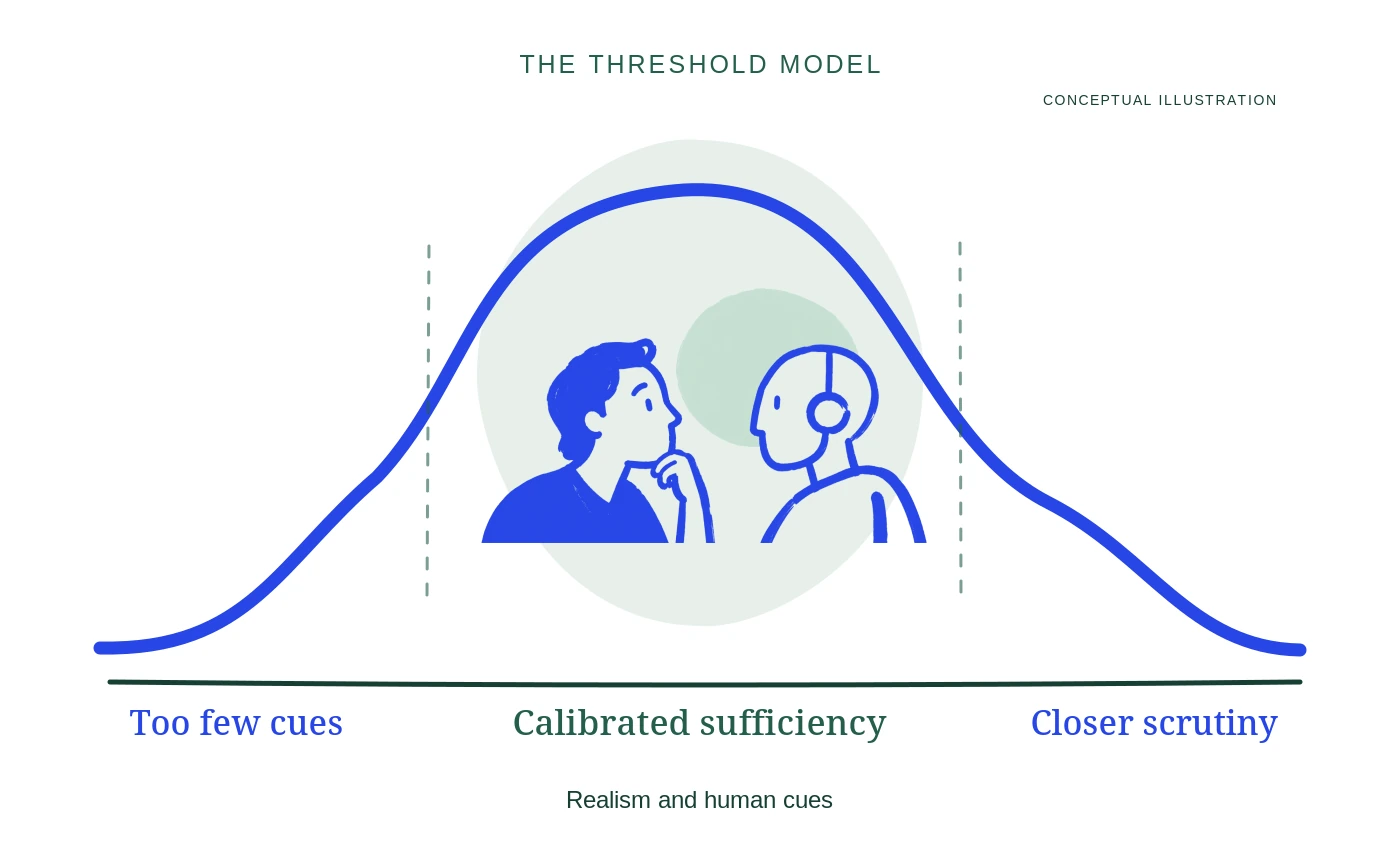
Where AI should act, and where people must decide
The same question now reaches every institution. The framework makes clear what AI may do, what must remain human and what will earn the confidence of the people affected.
The decision
Set the right boundaries for AI
Decide where AI may inform, persuade, teach, care or act, and where people must remain accountable.
What may AI advise, decide or execute, and who remains answerable?
What may AI do on behalf of the public, when must a person intervene and how can a decision be challenged?
What may AI teach, assess or produce, and where must faculty judgement remain?
What may AI recommend or invite, and where must human duty and dignity remain?
When AI shapes attention and influence, what must people know and be able to question?
From evidence to institutional decisions
The research programme examines role fit, disclosure, scrutiny, dependence and public judgement across AI personas. It gives boards, universities and public institutions a way to decide what AI may do, where human accountability must remain and what evidence or recourse people need to trust the result.
The wider vocabulary includes the transparency tax, crowd forensics, burdenless listening, scrutiny composition and ontological load.
How to cite the term
Saxena, P., & Prahl, A. (2026). The authenticity paradox: The threshold model of synthetic authenticity. International Journal of Human-Computer Interaction. Advance online publication. https://doi.org/10.1080/10447318.2026.2680242