Synthetic authenticity
An AI persona is synthetic in form yet judged authentic enough to act on.
Synthetic authenticity is the condition where an AI persona is synthetic in form yet is judged authentic enough for a person to trust it, buy from it, learn from it, or confide in it. It locates authenticity in the audience's judgment rather than in any property of the system. A persona does not become authentic by being more human; it becomes authentic when a person decides it is real enough for the decision in front of them.
The authenticity paradox (IJHCI, 2026)
Versioned authenticity
Trust attached to a traceable version rather than a timeless system.
Versioned authenticity ties trust to a traceable version of an AI. Changes to its model, memory, rules, owner or role may mean people are dealing with a different system. Institutions need to know what changed and decide whether earlier permission still applies.
Synthetic Authenticity framework (working programme concept)
Version threshold
The change that requires identity and permission to be reviewed.
The version threshold marks when a change to the model, memory, rules or owner creates a meaningfully different AI. At that point, the institution needs to review its identity, role and permission.
Synthetic Authenticity framework (working programme concept)
Authority ceiling
The point where delegated authority must stop.
The authority ceiling is the most an AI may do without fresh human approval. An AI may inform, recommend, decide, transact or commit. Each step needs clearer limits and stronger oversight.
Synthetic Authenticity framework (working programme concept)
Reliance exposure
The dependence and consequence created by an AI relationship.
Reliance exposure describes how much people, institutions or markets depend on an AI and carry the risk of its actions. It connects relational AI and agentic commerce by asking who relies on the system, whom it represents and where interests may conflict.
Synthetic Authenticity framework (working programme concept)
Recourse window
The time and access available to challenge an AI outcome.
The recourse window is the time and route people have to challenge, correct or reverse an AI-mediated outcome. People need to reach an accountable person before the harm becomes harder to undo.
Synthetic Authenticity framework (working programme concept)
Legitimacy gap
The distance between what AI can do and what it has permission to do.
A legitimacy gap opens when an AI can do more than it has been given permission to do. It can grow when the model, memory, role, people it serves or stakes change without a fresh decision from the institution.
Synthetic Authenticity framework (working programme concept)
The threshold model of synthetic authenticity
Human cues help up to a threshold, then start breaking trust.
The threshold model holds that the relationship between human cueing and authenticity judgment is not monotonic. Below the threshold a persona reads as too thin to engage with. Above it, added realism invites scrutiny rather than trust. The design target is the threshold, not the maximum. Built from a map of 2,685 articles and 111 AI-persona studies.
The authenticity paradox (IJHCI, 2026)
Calibrated sufficiency
Enough cueing for the task, deliberately no more.
Calibrated sufficiency is the design position that follows from the threshold model. A persona should carry the cues the task requires and stop there. It reframes persona design from a realism race into a calibration problem, where the correct amount of human signal depends on the role the persona occupies and the stakes of the decision.
The authenticity paradox (IJHCI, 2026)
The transparency tax
AI disclosure may attract attention while making authenticity more salient.
The transparency tax names a trade-off described in a manuscript under review. In an observational analysis of 1,531 Instagram posts, disclosure was associated with 19.2 per cent higher engagement, while felt authenticity was lower where disclosure became unusually prominent.
The transparency tax on virtual influencer engagement (under review)
Collaborative persuasion knowledge
Persuasion knowledge assembled by a group rather than held by a person.
Persuasion knowledge has been treated as something an individual consumer holds. Collaborative persuasion knowledge describes what happens when it is assembled in public: one viewer's private suspicion becomes the next viewer's starting evidence, and the group can test and combine what no single member sees alone.
Crowd forensics and warrant braiding (Journal of Advertising, accepted and in production)
Crowd forensics
Comment threads behaving like investigations.
Crowd forensics describes the investigative register that public comment threads adopt around a suspected AI persona. Participants gather artefacts, compare frames, date images, and test claims. The thread stops being a reaction and starts being an inquiry.
Crowd forensics and warrant braiding (Journal of Advertising, accepted and in production)
Warrant braiding
Separate weak clues twisted into one strong shared verdict.
Warrant braiding is the mechanism by which individually inconclusive cues are combined into a verdict the group treats as settled. Each clue may be inconclusive on its own. Braided together and made public, the clues can carry more weight than they do separately.
Crowd forensics and warrant braiding (Journal of Advertising, accepted and in production)
Burdenless listening
Confiding in something that asks nothing back.
Burdenless listening describes accounts of people opening up to companion AI because the exchange asks for no reciprocal attention. Across 3,670 posts and reviews, that ease of disclosure also appeared in accounts of separation feeling like loss.
Burdenless listening in AI care markets (revise and resubmit)
Public advice adjudication
Private advice carried into a community and re-tried in the open.
Public advice adjudication is the sequence that runs from an inherited recommendation, to a carrier object posted in public, to community scrutiny, to adjudicated advice. It moves the research question from whether an individual trusts a source toward how a group reconstructs a recommendation it did not receive.
When advice goes public (under review)
Public advice object
A recommendation turned into something strangers can quote and edit.
A public advice object is a digitally persistent and editable representation of inherited advice. It has four separable elements: source attribution, recommendation content, carrier framing, and visible warrants. Once advice becomes an object, it can be reproduced, recombined, and rewritten by people who were not in the original encounter.
When advice goes public (under review)
Carrier framing
The stance the person carries the advice in with.
The carrier is the person who received advice and posts it for review. Carrier framing is the stance they express in doing so: credible, questionable, incomplete, overpriced, self-serving. Posting is already an adjudicative act, which is why the carrier's attitude must never be read as the community's.
When advice goes public (under review)
Scrutiny composition
Not how much a group criticises, but what it criticises.
Scrutiny composition asks where a community directs its critical attention rather than how much attention it pays. AI advice draws complaints that it is generic, templated, or missing context. Human advice draws questions about the adviser's diagnosis, procedure, necessity and incentives. The split measures 55.8 standardised percentage points, which is a compositional difference, not a volume one.
When advice goes public (under review)
Genericity scrutiny
The complaint AI advice attracts: broad, templated, context-free.
Genericity scrutiny records claims that advice is broad, templated, stale, prompt-dependent, insufficiently validated, or missing decision-relevant constraints. It is the accountability surface an AI-attributed recommendation exposes. In this corpus it concentrates in technology and electronics.
When advice goes public (under review)
Adviser-process scrutiny
The complaint human advice attracts: how did you get there?
Adviser-process scrutiny records questions about competence, diagnosis, procedure, necessity, honesty, incentives, or role suitability. It is the accountability surface a human-attributed recommendation exposes, and it runs 55.1 points higher for human advisers than for AI.
When advice goes public (under review)
Role-based acceptability
How much AI a role can carry before people object.
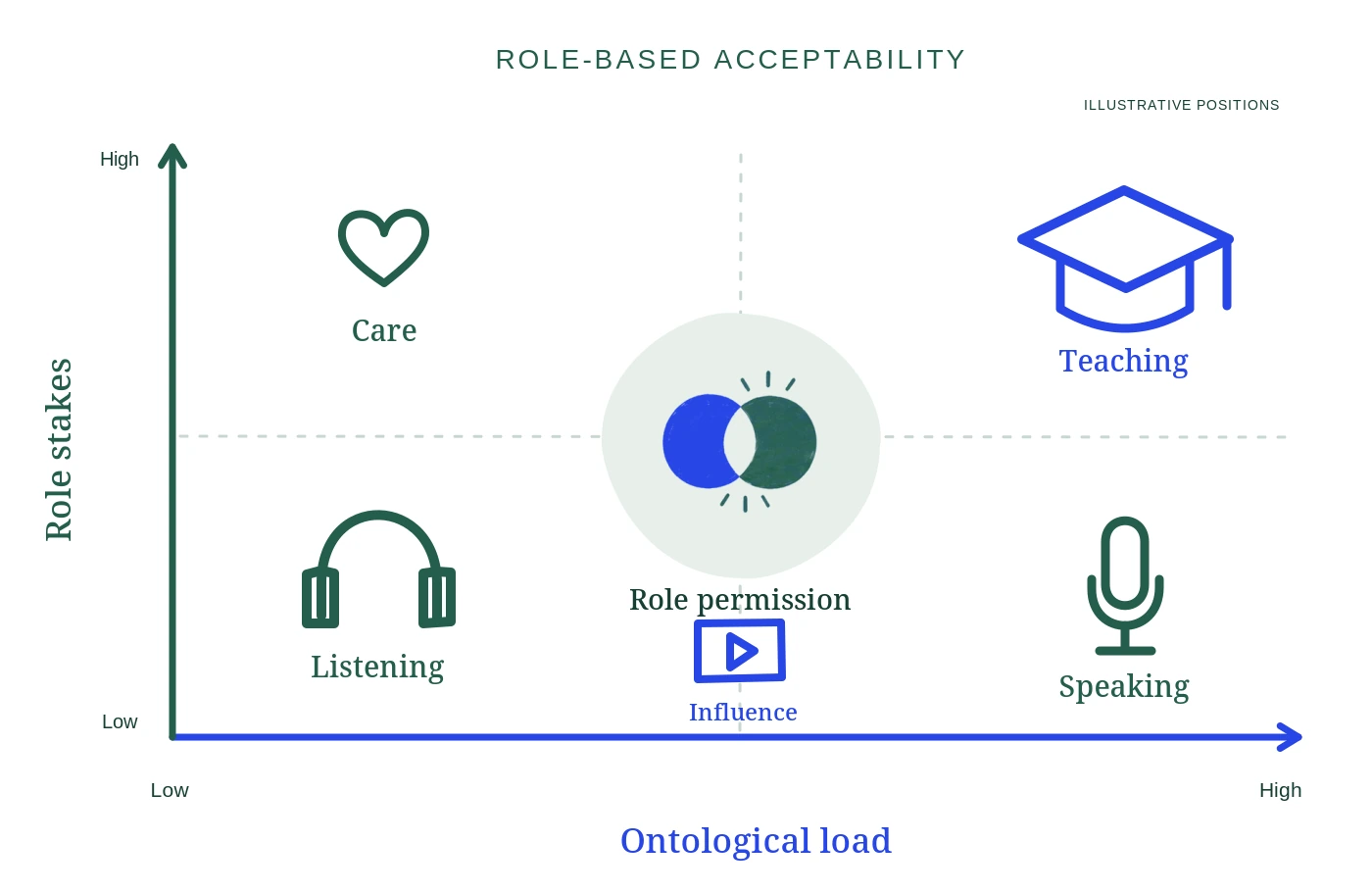
Role-based acceptability holds that tolerance for an AI communicator is set by the role it occupies rather than by the technology in it. The same system is unremarkable in one seat and unacceptable in the next, because roles differ in what is at stake and in how much the audience needs to know what kind of thing is speaking.
When the communicator is code (under review)
Ontological load
The effort of working out what kind of thing is speaking.
Ontological load is the cost a person carries when the category of their interlocutor is unsettled. People keep re-checking whether they are dealing with a person or a system. That repeated check can demand attention and shape what they are prepared to believe or permit.
When the communicator is code (under review)